Water Conservation
- Home /
- Water Conservation
Table of Contents
Introduction
The issue of water and its use is central to the concerns of our time.
Between droughts and intense rainfall, we can no longer hope to let our gardens benefit Seasonal cycles that our ancestors knew.
To accurately measure the garden's water needs, essential tools include a thermometer, a rain gauge, and a notebook and pencil for daily, empirical monitoring.
We know that the higher the temperature, the more water plants require to evaporate, leading to greater consumption. Soil type, cover, and geographical location must also be considered.
On average, plants need 100 to 120 mm of water per month. This represents 100 to 120 liters per square meter. During periods of intense heat, water consumption quickly reaches 150 liters per square meter, while restrictions are in place and a miraculous downpour is no longer possible.
Therefore, a simple calculation of water needs can be performed by taking into account the garden's square footage, temperatures, and recorded rainfall to estimate the required watering.
In a more technologically advanced version, there are weather stations that can provide daily monitoring and integrate this data into a data analysis system to automate watering.
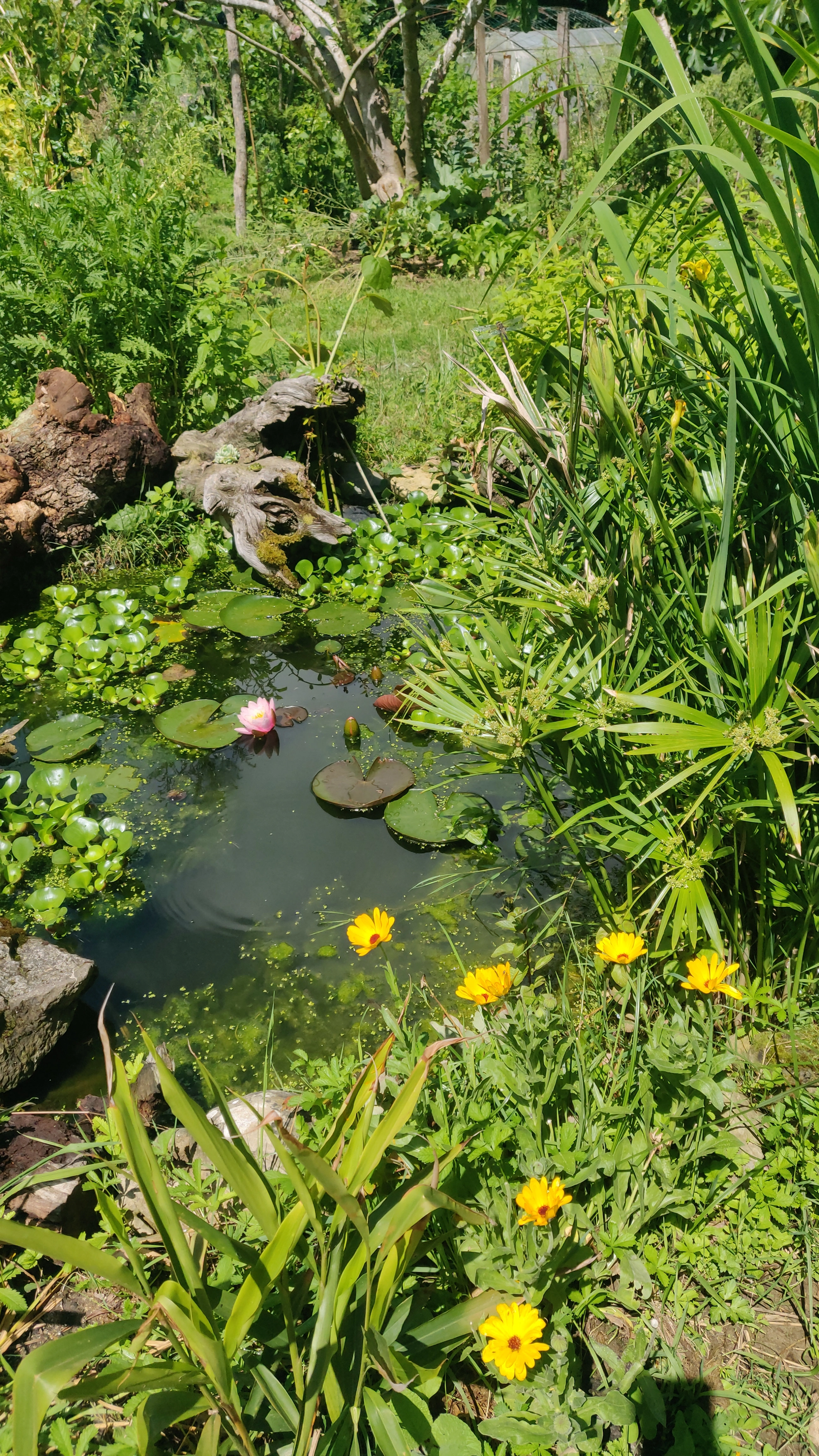
Water, a treasure to preserve
To supplement the amount of water needed for your garden during periods of drought, several strategies can be combined:
- having reserves collected during periods of heavy rainfall,
- limiting soil drying as much as possible through plant cover and mulching,
- recycling tap water used daily,
- controlling watering to avoid waste while preserving your plants,
- optimizing certain water-consuming tasks.
Water Collection and Storage
Ideally, water will complete different cycles. I recommend Hervé Covès’ video on this topic. The 7 Water Cycles. (https://www.youtube.com/watch?v=ZhtQ89NzOjs&t=1637s “The 7 Water Cycles”) Therefore, even though various forms of water collection and storage can be considered to prevent water shortages, they will never replace the presence of forests, which play a vital role in capturing and redistributing this resource.
However, planning for reserves has become necessary to cope with unforeseen events, and various systems are possible. Generally, a rooftop represents an excellent collection area, easily accessible in tanks via gutters.
Ponds or basins can also be created for this purpose. However, if the goal is to maintain aquatic flora and fauna, it is advisable not to use them for irrigation.
Recycling Greywater
Infos
The average water consumption per capita in France is 145 liters per day, or 53 m³ per year, distributed as follows:
- Hygiene (showers, baths): approximately 39% of consumption
- Cooking and dishwashing: 15%
- Toilets: 25%
- Laundry (washing machine): 10%
- Other (cleaning, watering, etc.): 11% Source: gouv.fr
Since toilets account for 25% of water consumption, you can directly save 36 liters of water (13 cubic meters per year) simply by using a dry toilet.
To partially reuse greywater from your home, you can simply redirect the wastewater from your kitchen sink, bathroom sinks, and bathtub, and filter it before using it in your garden.
If the house is equipped only with dry toilets, it is entirely possible to collect all the wastewater and redirect it to filters and constructed wetlands.
In this case, we reuse 100% of the water consumed.
Réflexions Préliminaires
To recycle greywater in the garden, we need to consider the cleaning, cosmetic, and chemical products used in the home and replace them as much as possible with products that don’t pose a risk to the environment, especially if you consume what you produce. In this regard, a separate drain can be used for problematic products to ensure their optimal collection and recycling.
Saving Water When Watering ?
The question may seem absurd, but it’s far from trivial.
Even just considering the plants, trees, and shrubs that we plant or sow throughout the year, using water continuously, isn’t letting them die from lack of water a waste of all the water invested initially? Especially since we’ll have to start all over again if it fails.
The savings will only be truly effective when the plants’ needs are met, but that’s not all. Indeed, plant life is linked to soil life, and everything that lives needs water. It is therefore essential to properly hydrate your garden and prevent it from drying out.
There are tools available to measure soil moisture and verify that this essential criterion for the life of plants, as well as their microscopic companions, is being met.
To go further, the judicious use of sensors to measure the humidity of different areas of your garden, once integrated into an automated system, allows you to water without unnecessarily wasting water while ensuring that the needs of the microbiota are met.
Optimizing Water Use
Here are some examples of practices that avoid overconsumption of water :
- Sow and transplant flowers and vegetables before a rain shower.
- Respect the seasons by planting trees and shrubs at the right times for better establishment and thus less watering later on.
- Prioritize the use of rainwater from rainwater harvesting systems and reservoirs, while ensuring that rainwater inlets are well-maintained to ensure maximum water quality.
- Establish distribution points using tanks or channels, maximizing the use of gravity.
- Ideally, install a pipe network with taps and use this network as the main irrigation system for the plots.